Scattered knowledge
Procedures, reports, presentations, messages, and business documents remain spread across many spaces.

Document and AI infrastructure
Nexus collects, structures, and governs your documents to retrieve useful information, produce source-linked answers, and power AI use cases — in an environment your company controls.
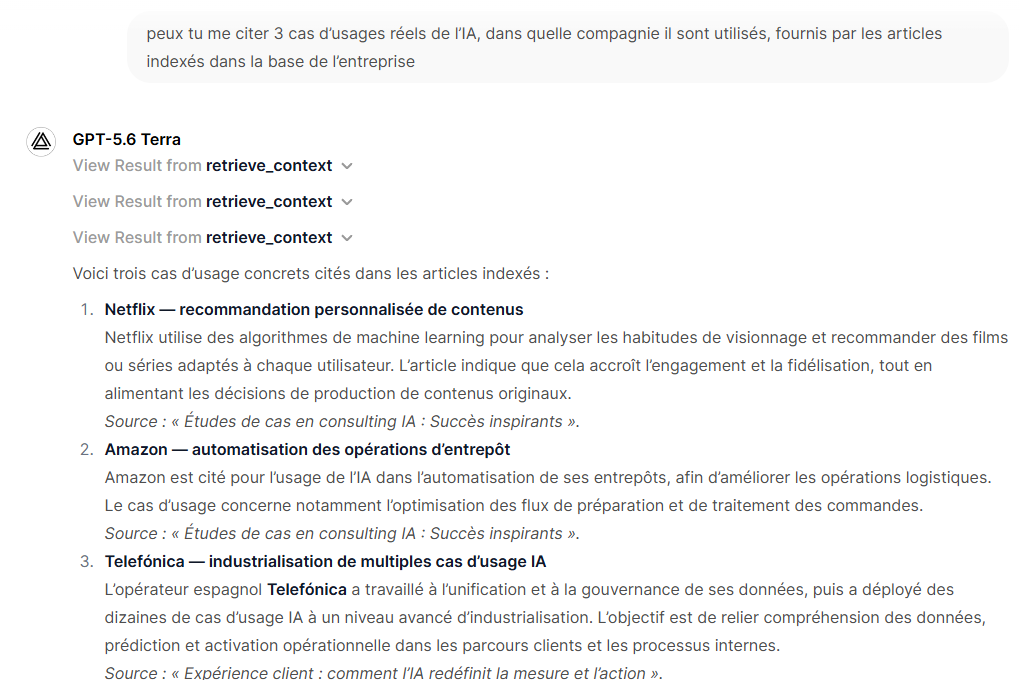
General-purpose assistants can produce text. They do not inherently know your company’s current documents, access scopes, or the sources an answer should rely on.
Procedures, reports, presentations, messages, and business documents remain spread across many spaces.
Users have to upload files, copy passages, or rebuild context for every new request.
Giving an assistant access must never mean opening all company knowledge.
Without retrievable documentary references, it is difficult to review, validate, or deepen an answer.
Each new application risks rebuilding its own storage, context, and rules.
Without shared observability, the models used, latency, errors, and AI spending remain hard to manage.
Full product demonstration · 20 minutes · English
Understand Nexus through a complete, step-by-step walkthrough of the product and its interface. Allow approximately 20 minutes for the full demonstration.
Complete walkthrough · English audio
Nexus turns scattered documentary sources into structured, authorized, reusable knowledge without imposing the same interface on every use case.
Sources
Nexus
Uses
Application sources are available according to integrations and the Nexus ecosystem configuration, including through Composio.
The interface or model can change. Nexus retains the document structure, permissions, references, and operating rules.
Nexus WebUI is Nexus’s conversational chatbot. Users ask questions in natural language and receive an answer alongside the passages and sources retrieved within their scope.
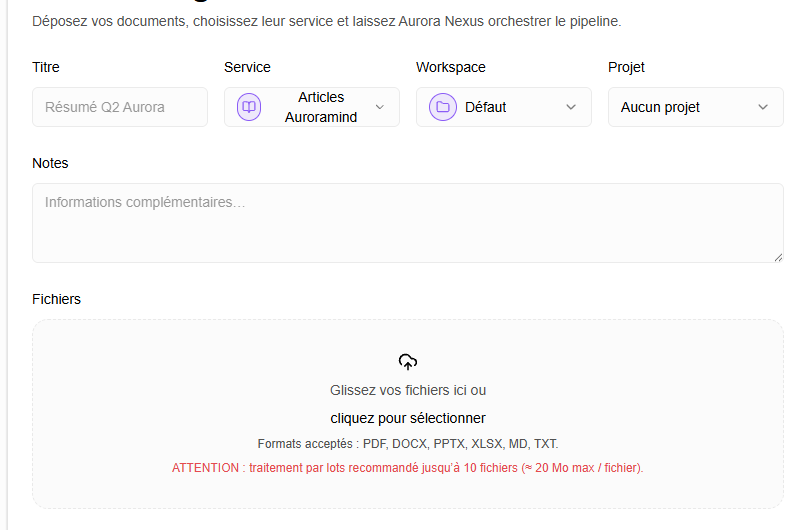
Service → Workspace → Project
Selecting a scope makes search easier, but never creates an entitlement. Permissions enforced by Nexus remain authoritative.
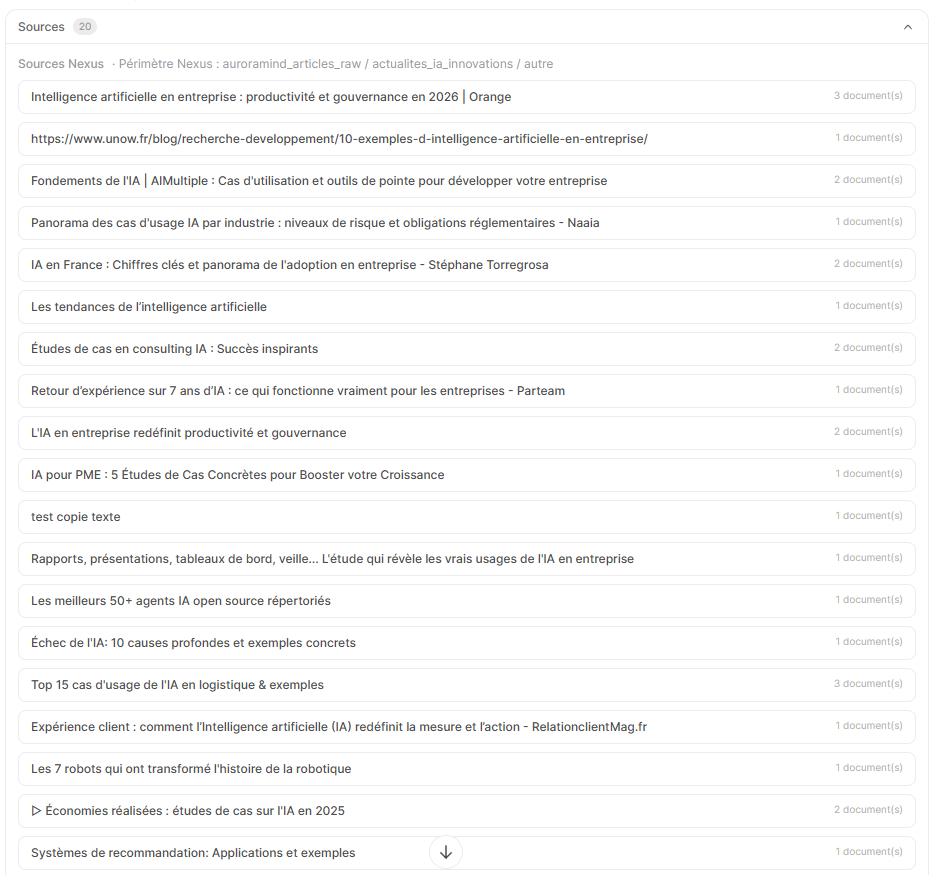
Nexus lets teams start with very concrete questions, then progressively extend the same foundation to other teams and applications.
Nexus searches only authorized documents and returns the procedure with its sources.
With the Heavy profile, Nexus can use text, tables, and extracted images, then return the relevant passage, page, and image when available.
Agentic Search can cross-check documents, reread relevant passages, and distinguish verified, partial, or not-found results.
A company can use Nexus’s API-first foundation to create its own products, portals, assistants, or workflows without rebuilding the document layer, permissions, and observability.
Nexus keeps source files in object storage controlled by the company, then orchestrates extraction, normalization, chunking, and indexing.
Import → Extract → Structure → Index
The formats actually accepted depend on active ingestion profiles. TXT is supported through configuration.
The Heavy profile is designed for documents with many images, charts, tables, or pages that are difficult to extract. It can use OCR, table analysis, image description, and page-level information retention.
During a search, Nexus can therefore return the passage, page, relevant image, and its analysis when those elements are available in ingestion artifacts.
Classic document search answers most questions quickly. Agentic Search investigates requests that require several searches, rereading, and more structured verification.
Question → Relevant passages → Context → Answer → Citations. Suitable for everyday search, procedures, summaries, and direct documentary questions.
Complex question → Requirements to check → Successive searches → Open documents → Gather evidence → Verify → Answer.
Verified
Partially verified
Not found in authorized sources
The verification status results from checks orchestrated by Nexus. The model does not decide alone that an answer is verified.
The documentary scope is defined by Service, workspace, and project. The calling application is identified separately for authentication, quotas, caching, traceability, and observability: it does not define the corpus and cannot broaden rights.
Tenant → Service → Workspace → Project
Rights are applied by Nexus during search and again when documents are opened. A model cannot decide to broaden its scope.
Nexus can be deployed on infrastructure controlled by the company: locally, on a server, a VPS, or suitable cloud infrastructure.
Provider keys are encrypted and never exposed in the browser. The company can use its own contracts, choose providers, and track the related costs.
Nexus tracks queries, models, providers, latency, costs, tokens, caches, citations, feedback, ingestion, and component states.
The assistant and model can change. Corpora, permissions, sources, evidence, and usage rules remain governed in Nexus, inside the environment your company controls.
Nexus does not confine company knowledge to a single chatbot. Its capabilities are available through the WebUI, API, and three specialized MCP servers.
Lets an assistant query corpora, documents, and RAG functions accessible to the signed-in user. It exposes neither administration nor ingestion.
Lets authorized agents explore documents, resources, relationships, neighbors, subgraphs, and context packs in the document Knowledge Graph. Read-only access.
Gives developer agents a structural memory of applications. Most tools are read-only; a controlled regeneration requires a specific scope and explicit confirmation.
The API lets applications reuse ingestion, search, RAG answers, citations, documents, scopes, media, projections, graphs, and authorized administration functions.
MCP means Model Context Protocol. These servers let a compatible assistant or agent use Nexus capabilities as structured tools, with the permissions and scopes enforced by Nexus.
Nexus already provides the foundation for Nexus Pocket, Nexus Knowledge Studio, Silio, and Aurora Atlas. The same API-first architecture lets each company create its own applications, products, and agents.
These assistants are excellent general-purpose interfaces. Nexus serves a different need: making company knowledge durably available, governed, and reusable across several AI use cases.
Online assistants
general-purpose interface and capabilities
knowledge dependent on the model and supplied context
spaces, files, and connectors according to the chosen offering
experience mainly centered on the assistant
uploads and copy-paste when context must be rebuilt
Nexus
self-hostable document infrastructure
corpora organized by Service, workspace, and project
server-side permissions
citations and documentary references
API for applications
MCP for authorized agents
choice of providers and models
usage, cost, and performance tracking
Nexus does not aim to replace every assistant. When they are connected and authorized, it gives them structured, governed, retrievable company knowledge.
The first level explains value. These details provide the architecture, operations, and integration evidence technical teams need.
A procedure to retrieve, reports to query, an internal assistant to connect, or a business application to build: start with the concrete need and the relevant documentary scope.
Discuss my use case